The 3 a.m. Services: A Night Atlas of Britain’s Loneliest Motorway Stops
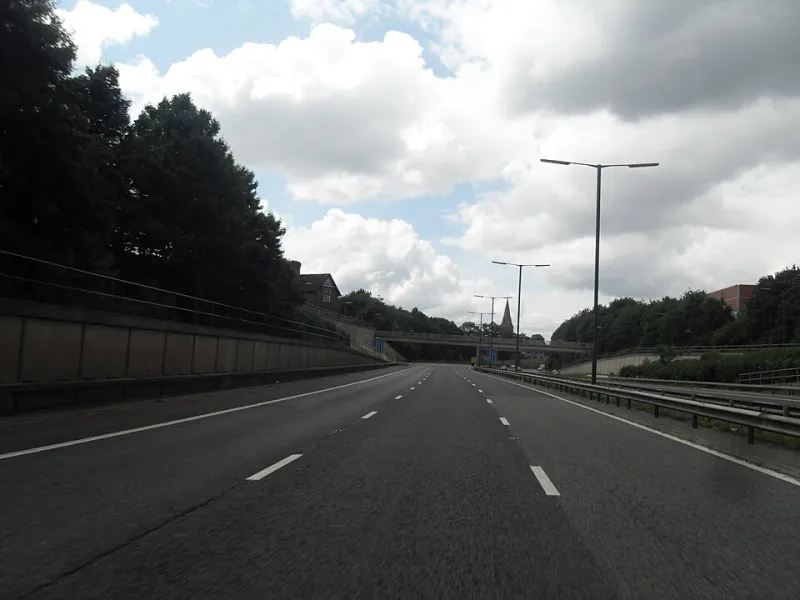
Photo: Anthony Parkes , CC BY-SA 2.0, via Wikimedia Commons
At 3 a.m., Britain’s motorway services become something else. The signs still say 'Welcome Break' or 'Moto' or 'Roadchef', but the welcome has gone home. The car park is a grey sea. The lights buzz. The coffee machine has the look of a witness. You are not quite nowhere, because there is a Costa and a WH Smith, but you are not quite anywhere either. These are places designed to be passed through, and that is exactly why they feel haunted.
The motorway service station is a liminal space in the plainest sense: a threshold between journeys, a stop that is not a destination. In folklore, liminal places attract strange stories. Crossroads, bridges, doorways, the hour before dawn. The services has all of that, plus a Greggs. It is a non-place with a car park, and the car park is where the ghosts wait.
The Rules of the Liminal Services
A good haunted services has a few ingredients. The lighting must be fluorescent and slightly too bright, so that shadows feel like mistakes. There should be a corridor with no clear end. The car park should be large enough that your car becomes a small, vulnerable object. Ideally, there is a patch of grass or a hedge beyond the lights, suggesting a wider darkness that the building is trying very hard to ignore. And there should be a faint smell of disinfectant and fried food, because horror is always more convincing when it smells like lunch.
The folklore clings to these places in predictable ways. There is the phantom hitchhiker picked up on the slip road. There is the lorry driver who stops for a break and never leaves. There is the woman in the high-vis who asks for a lift and then vanishes before the roundabout. None of these stories are unique to one service station, and that is the point. They are interchangeable, like the services themselves. The ghost story is another thing designed to be forgotten.
A Night Atlas, Ranked by Creepiness
This is not a scientific ranking. It is a field guide, compiled from late-night stops, bad coffee and the kind of instinct that makes you lock the car doors before you have even turned the engine off.
1. Clacket Lane, M25
Clacket Lane has the particular menace of a place that is close to London but feels far from it. The car park is huge, the trees press in, and the building has the air of a conference centre that has been abandoned mid-event. At night, the walk from the car to the main doors is long enough for your imagination to fill the silence. It is not the most picturesque services in Britain. It might be the most likely to make you walk faster.
2. Watford Gap, M1
Watford Gap is the elder statesman of British services, and it carries its history heavily. It has been a stopping point for decades, which means it has absorbed a lot of tiredness. The building is functional, the lighting is relentless, and the whole place feels like a waiting room for a train that is not coming. There is a reason it has a reputation. It is not spooky in a theatrical way. It is spooky in the way that a long corridor is spooky when you are the only person in it.
3. Scotch Corner, A1(M)
Scotch Corner is where the motorway meets the moors, and the atmosphere changes accordingly. The wind is louder. The car park feels exposed. Beyond the lights, the country is big and dark and indifferent. If you stop here late at night, you get the sense that the services is not a refuge but a small island of electricity in a sea of heather. That is not a comforting thought at 3 a.m.
4. Membury, M4
Membury has the split-level layout that makes every services feel like an airport terminal designed by a committee. The corridors branch. The stairs lead to more corridors. The car park is on a slope, so you are always looking down at rows of cars that seem to have been left there for years. It is not obviously haunted. It is just quietly wrong, like a dream about a building you have never been in before.
5. Charnock Richard, M6
Charnock Richard is a labyrinth. Bridges, walkways, ramps, a main building that seems to have grown extra limbs. At night, the fluorescent light makes the concrete look damp. The car park is vast. The whole place has the energy of a service station that has been waiting for someone to notice it is still open. If you are going to meet a ghost on the M6, this is where it would happen.
6. Fleet, M3
Fleet is the polite one. It is neat, well-lit and almost aggressively normal. That is what makes it unsettling. The bins are empty. The tables are clean. The car park is quiet. It feels like a stage set for a services, waiting for the actors to arrive. At 3 a.m., normality is the strangest thing of all.
Why We Haunt Places Designed to Be Forgotten
The motorway services is not built to be remembered. It is built to be used and left. That is its purpose. And yet we tell ghost stories about it. We imagine a figure at the edge of the car park, a face in the window of a parked car, a voice in the corridor. We do this because liminal places ask us to fill the silence. The services is a gap in the journey, and gaps attract stories.
There is also something honest about it. Most haunted places in Britain are old: castles, pubs, churches, stately homes. The services is new, and it is still haunted. That suggests the haunting is not about history. It is about us. It is about the tiredness, the anonymity, the strange intimacy of being alone in a public place at an hour when you should be asleep. The ghost is just a way of making that feeling visible.
So next time you stop for a break on a long drive, pay attention. The coffee is stale. The lights are buzzing. The car park is empty. And somewhere beyond the edge of the floodlight, there is a dark patch that might be a hedge, or might be something else. You do not have to believe in ghosts to drive away a little faster. You just have to be British, and tired, and far from home.