Shutters, Murals and the Sodium Glow: Britain’s High Street as Horror Set, 2026
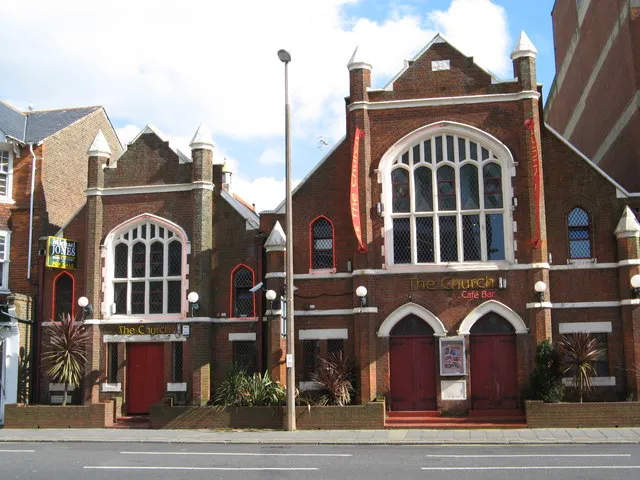
Photo: Josie Campbell , CC BY-SA 2.0, via Wikimedia Commons
At 8.47pm on a wet Thursday in 2026, the most frightening place in Britain is not a remote moor, a decommissioned hospital or a forest with too many cairns. It is the pedestrianised precinct of a medium-sized town after the shops have shut. The shutters are down. The bus station glows. A sign above a vape shop flickers with the patience of a trapped wasp. Somewhere a temporary mural is peeling away from a boarded window. This is not a location that a film crew built. It is a location that we built, and then stopped maintaining. That is why it works.
The New Location Shoot
Horror has always borrowed from the everyday. The terraced house, the caravan park, the retail park — these are ordinary spaces made strange by lighting, framing and a lack of people. In 2026, the ordinary space that gives the most for the least is the British high street. You do not need a fog machine. You need a Sunday evening and a closed branch of a value supermarket. The set is already dressed.
The old shorthand was the abandoned hospital, the asylum, the remote village with a pub full of locals who go quiet when you enter. Those still work, but they are heritage horror. They belong to a Britain of institutions and isolation. The high street is different. It is not abandoned. It is half-alive. That is much worse.
Field Guide: The Shutter Cathedral
The shutter is the high street’s most reliable horror prop. It is a lid. It says: this place has a life, but not now. Greggs, Poundland, the betting shop, the phone repair kiosk — each one becomes a blank screen after closing. The corrugated metal catches the sodium light and turns it into something industrial. If you stand still long enough, the shutter starts to look like a wall in a prison film. The fact that it will roll up again at 9am is not reassuring. It is the point.
Field Guide: The Mural of Denial
The temporary mural is a relatively new arrival. You have seen it: a phoenix, a community poem, a cartoon bee, a slogan about loving where you live, painted onto boards that cover the windows of a unit that no longer has a tenant. The intention is hope. The effect is eerie. A mural over a dead shop is a painted smile over a missing tooth. It tells you that someone cared enough to cover the hole, but not enough to fill it. In horror terms, it is a sigil. In civic terms, it is a bandage.
Field Guide: The Flicker
A flickering sign is a small failure of maintenance that reads as a signal. The sign above the nail bar says OPEN, then OPE, then nothing, then OPEN. There is nobody inside. The flicker is not supernatural. It is a loose connection. But the brain does not care about your electrical knowledge. It sees a message from a system that is still running without its people. This is the same reason liminal-space videos work: empty corridors, humming lights, a world that continues after the humans have left.
Field Guide: The Empty Unit That Isn’t
The high street is not simply empty. That is the lazy version. It is full of things that have moved into the gaps: charity shops, pop-up barbers, church outreach centres, vape shops, American candy stores, temporary art spaces. Some of these are signs of life. Some are signs of an economy that has run out of ideas. The horror is not vacancy. It is persistence. A unit that keeps reopening as something slightly worse is more unsettling than a unit that is boarded up forever.
The Bus Station Threshold
The bus station is the green room of the night. It is where people wait, smoke, argue, sleep and watch. It has the lighting of a film set and the acoustics of a public toilet. The timetable is a prophecy that nobody believes. If you want a British horror scene in 2026, do not bother with the graveyard. Put two characters in a bus shelter at 11pm and have one of them say, ‘It’s quiet tonight.’ That is enough.
Don’t Mourn, Notice
There is a temptation to turn all of this into a lament for the high street. That is understandable, but it is not the most interesting response. Retail decay is a political failure and an economic one. It is also an aesthetic fact. The high street has become a backdrop for dark fiction and internet folklore because it is already lit, already empty and already full of signs that mean less than they used to.
The point is not to romanticise decline. The point is to notice what decline looks like. Horror is a way of paying attention. It takes the ordinary and asks what it would feel like if the ordinary stopped working. In 2026, the answer is not a remote castle. It is a town centre with one working lamp and a mural of a bee. The most unsettling thing is not the closed shop. It is the one that opens at 9am with nobody in it.