Aisle 12, Sub-Level: The Cold War Rooms Beneath Britain's Everyday Places
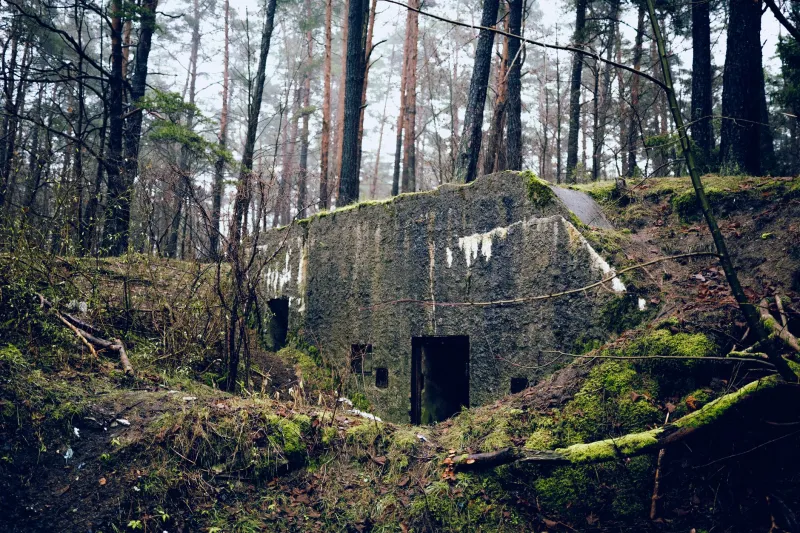
There is a particular kind of British unease that arrives not in a graveyard but in a car park. You are standing beside a trolley bay, somewhere off a ring road, and someone tells you that beneath the tarmac is a room designed for the end of the world. Not a museum. Not a tourist attraction with a laminated map. A room with ventilation filters, a duty officer's log and a stack of forms for counting the dead.
The Cold War did not only produce silos and radar stations. It produced a papery, bureaucratic afterlife that was tucked under ordinary things: a council office in Essex, a telephone exchange in the Midlands, a stockroom behind a retail unit, a hatch in a suburban pavement that nobody looks at twice. The point was never spectacle. The point was camouflage.
The aesthetics of not being noticed
Britain's civil-defence programme was built on a very British instinct: if you cannot make a thing invisible, make it dull. Regional seats of government, emergency control centres, fallout shelters and monitoring posts were often concealed inside buildings that already belonged to the landscape of administration. A car park was a car park. A council annexe was a council annexe. A retail park was, and remains, a retail park.
That is what makes the discovery unsettling. The bunker is not hidden in a remote valley. It is under the place where you buy a duvet and a sandwich. The ordinariness above ground becomes a kind of disguise, and once you know it is there, the disguise stops working. The fluorescent lights feel less neutral. The service corridor feels less like a service corridor. You start wondering what else is beneath the country you walk across every day.
Concrete, clipboards and the horror of admin
The fantasy version of a bunker is cinematic: alarms, torchlight, a heroic last stand. The reality, as historians of civil defence have long pointed out, was closer to office work under extreme pressure. Emergency rooms were equipped for communication, rationing, coordination and record-keeping. The horror is not a monster in the corridor. The horror is a clipboard.
There is something deeply strange about the idea that Britain's answer to nuclear catastrophe was a room with a kettle, a telephone and a set of instructions for maintaining something called 'essential services'. It is the same instinct that gives us emergency planning today: the belief that if the paperwork is in order, the unthinkable can be managed. The bunkers are not frightening because they are secret. They are frightening because they are so recognisably bureaucratic.
Why 2026 makes the concrete hum again
For years, these spaces were heritage: Cold War tourism, local-history talks, the occasional open day. But 2026 has a different mood. We have spent the decade talking about resilience, supply chains, emergency alerts and infrastructure. The language of preparedness has crept back into ordinary life, not as a Cold War rerun but as a low background hum. In that context, the bunkers stop feeling like quaint leftovers and start feeling like a mirror.
The question they raise is not 'could it happen again?' It is 'what would we actually do?' The answer, judging by history, is likely to involve a designated room, a chain of command and a great deal of improvisation. That is less comforting than a bunker. It is also more honest.
The hatch behind the till
What lingers is the geography. Britain is a country that hides its contingency plans under its retail parks and its council offices. The same nation that built pillboxes on beaches and listening posts on hills also built quiet rooms beneath the places where we park and shop and queue. The two things belong together: the dramatic defence and the dull one, the visible ruins and the invisible admin.
So next time you are in a supermarket aisle, or a car park, or a civic building with a slightly too-solid door, consider the sub-level. Not because there is definitely a bunker there. Because the possibility is enough to change the temperature of the room. The ordinary place becomes a lid. And lids, once you notice them, are very hard to ignore.